
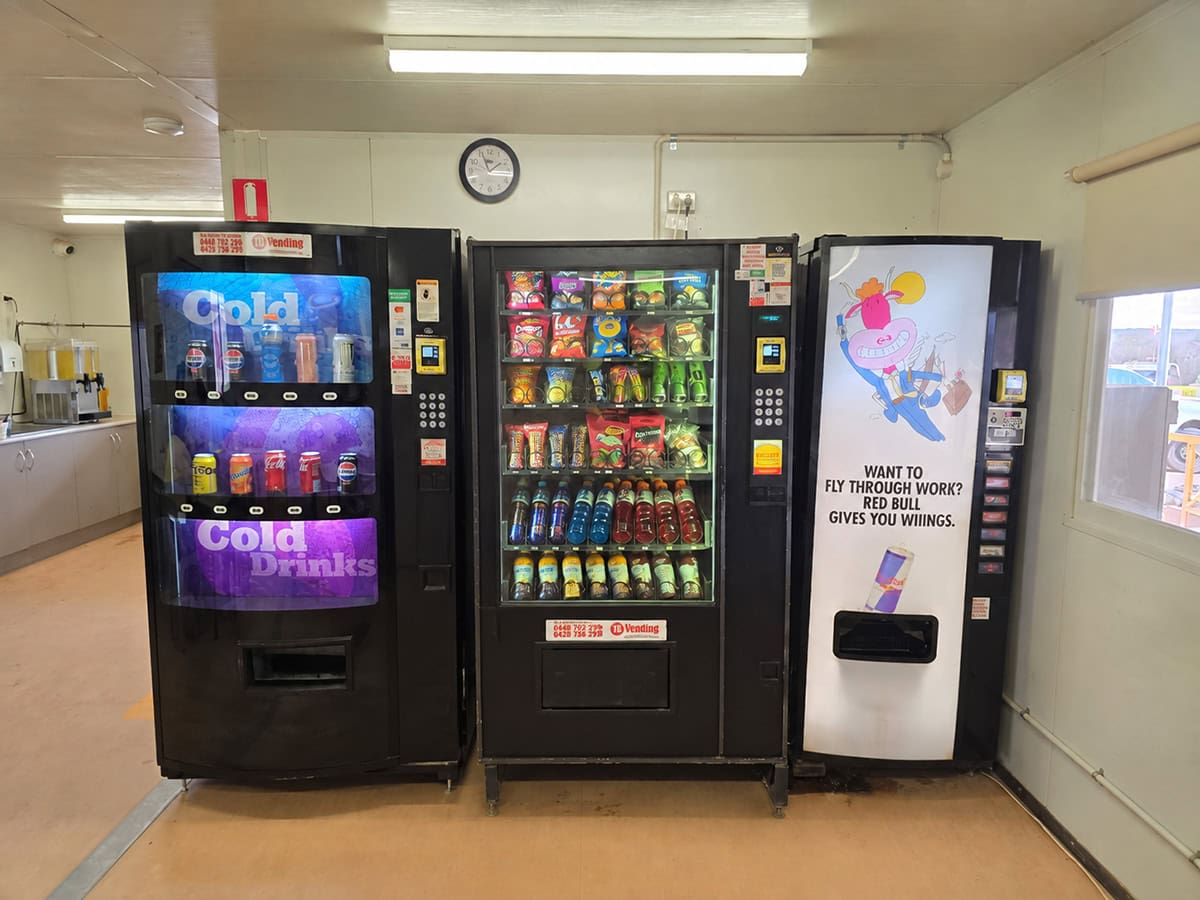
Most site managers who ask about a free vending machine are really asking one thing: will a supplier place a machine on my site? The free vending machine requirements are practical and easy to check, and on a remote WA worksite, distance matters as much as headcount. A1 Vending has serviced vending machines across Kalgoorlie-Boulder and the WA Goldfields since 1997, supplying and installing machines at no cost to suitable sites, so this guide sets out the factors that decide whether a site is suitable and how to check yours before you ask.
In short: the free vending machine requirements for a WA worksite are enough regular users to keep a machine selling, a sheltered location with a standard power point, access for a technician, and a site within a practical service run of Kalgoorlie-Boulder. A1 Vending assesses each site individually and covers the machine, installation and servicing at no cost to suitable sites.
What a free vending machine means on a WA worksite
Free vending machines are a managed service. The supplier owns the machine, installs it, stocks it and services it, and earns its return from the products sold through it. For suitable sites, A1 Vending supplies and installs the machine at no cost, and the site provides a location and a power point. Customers still pay for their own snacks and drinks, so “free” describes the machine and the service.
That is why the free vending machine requirements focus on two questions: will the machine be used enough to justify the service, and can the supplier reach the site reliably? Everything else on the list supports one of those two answers.
The six free vending machine requirements at a glance
Every supplier sets its own limits, and A1 Vending assesses each site individually. These six factors decide the outcome on most WA worksites:
- Regular users: enough people using the area each day, across every shift, to keep the machine selling.
- A sheltered location: indoors or under cover, in a crib room, site shed or amenities area.
- Power: a standard power point within reach of the chosen spot.
- Technician access: sign-in, induction and access steps the technician can complete.
- Service run distance: a site that sits on a practical run from Kalgoorlie-Boulder.
- A site contact: someone who can confirm the location and arrange access.
The next four sections take the factors that most often decide the result, one at a time.
Regular users and shift patterns
A machine earns its place when enough people use it. On a WA site that means counting people across the whole roster, since a crib room that serves several crews through a 24-hour operation gives a machine more daily use than a single-shift room of the same size.
No single headcount fits every site, because shift patterns, break times, and layout change the result. The most useful details to have ready are the number of people on site, how many shifts run and where people take their breaks.
For example, a site with two crews on 12-hour shifts and one shared crib room has two busy break windows every day, and a machine in that room is used in both. The same machine in a room that only one small team visits sees far less traffic, which is exactly what the assessment looks at.
Rosters matter as well. On a fly-in fly-out site, restocking is planned around the roster, so the pattern you work to is worth sharing early.
Location and power
Location affects how well a machine performs and how easily it is serviced. Wherever possible, machines go indoors or under cover, in a crib room, site shed or amenities area, which protects them from dust and heat. The site provides a standard power point within reach of that spot.
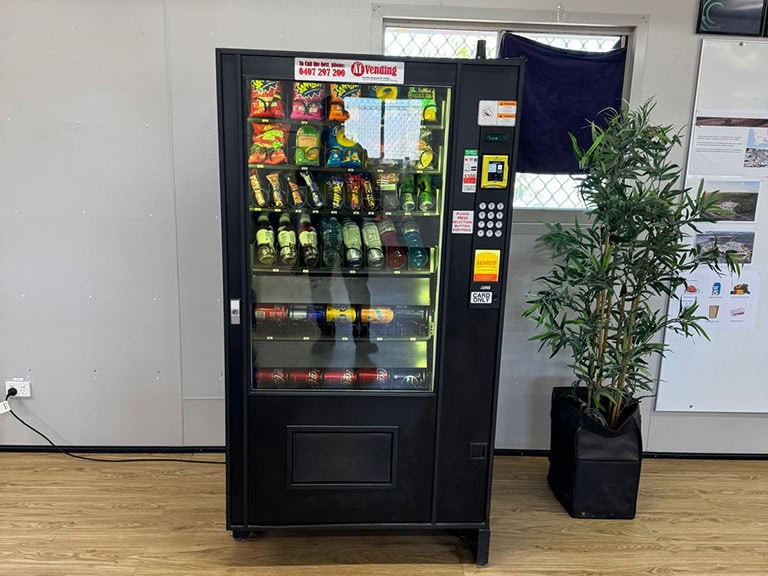
Clearance counts too. Leave room for the door to open and for air to move behind the machine, since good airflow helps the refrigeration system cope with a Goldfields summer.
Technician access and induction
A technician has to reach the machine, so site access matters. On mine sites and larger construction sites, that usually means sign-in, a site induction and the site’s own access procedures. A1 Vending’s technicians in Kalgoorlie are inducted for mine sites and follow each site’s access and safety procedures.
Sharing access details at the start, including who runs inductions and any restricted areas, keeps the first visit on schedule.
Distance and service runs
Distance is where remote WA sites differ most from city workplaces. A1 Vending is based in Kalgoorlie-Boulder and services sites across the Eastern Goldfields hub (Kalgoorlie-Boulder, Coolgardie, Kambalda, Southern Cross and Marvel Loch) through to the northern mining corridor, including Leonora, Leinster and Laverton, with structured service runs reaching sites up to 600 kilometres from Kalgoorlie.
Restocking is planned around headcount, roster and run distance, so a site further out is scheduled onto a loop that suits the whole route. The service areas page lists the towns covered, and a site beyond them is still worth asking about.
How remote WA sites differ from city workplaces
City guides often describe the free vending machine requirements in terms of office headcount alone. A remote worksite adds distance, rosters, heat and dust, and a crib room that may be the only place to buy a cold drink for hours. A1 Vending is based where the sites are, so Goldfields machines are served from a local depot, with technicians, vehicles and parts starting each day in Kalgoorlie-Boulder.
Heat and dust shape the details. A machine in a sheltered crib room runs more reliably through a Goldfields summer than one in direct sun, which is why location sits so high on the list. Cold drinks matter most in summer, when crews rely on the crib room to break the heat.
Why suppliers set free vending machine requirements at all
Free placement works because the supplier recovers costs through product sales, so every machine must sell enough to cover the machine, the stock, and the service run that keeps it filled. On a remote site, the run is a real cost, which is why distance and usage are weighed together.
Meeting the free vending machine requirements shows that a machine will earn its keep, and it protects the site too, because a machine that sells well stays stocked and serviced.
Where a vending machine fits alongside required site facilities
A vending machine adds convenience, and it sits alongside the facilities a site must already provide. WorkSafe WA’s guidance on the work environment and facilities states that clean drinking water must always be provided free of charge for workers, and it sets out what remote workplaces should consider for breaks and eating areas.
Source: WorkSafe WA, Work environment and facilities (Government of Western Australia).
A vending machine adds cold drinks and snacks on top of that baseline, and it works best in the spaces where crews already take their breaks. Welfare planning stays with the site, and a machine supports it with a place to buy a cold drink or a snack whenever the crib room is open.
Free vending machine requirements for mine, construction and workshop sites
The same six factors apply across site types, with different weight on each. On mine sites, access procedures and service run distance usually carry the most weight, which is why mining vending machines on remote leases are planned around the run. Civil and building projects have their own pattern, and the guide to construction site vending machines covers it. Workshops, depots and yards are covered in our guide to work site vending machines.
For offices and general workplaces, the same factors apply to any workplace vending machine, and the guide to the vending machine service for WA workplaces explains what to expect once a machine is in place.
Camps and villages follow the same logic. A communal crib room that runs around the clock gives a machine steady use across shifts, and the camp manager is usually the best site contact for access and roster details.
A ten-minute check of your own site
You can test if your site is eligible for a free vending machine in about ten minutes:
- Count the people who use the crib room or break area across a full roster cycle.
- List the shifts and when breaks happen.
- Choose the spot for the machine and check for a power point and clear floor space.
- Note the access steps a technician would follow, including induction.
- Check your site against the towns and runs on the service areas page.
- Name the person who will confirm details with the supplier.
Three things worth confirming with any supplier
Whichever supplier you speak to, three answers tell you most of what you need to know:
- Who owns the machine and who services it.
- How faults are reported and when someone responds.
- How restocking is scheduled around your roster.
With A1 Vending, the supplier owns and services the machine, fault reporting is open 24 hours, and restocking is planned around headcount, roster and run distance.
What happens after you ask
Once the checklist reaches A1 Vending, we assess the site individually. A1 Vending confirms whether the location fits a practical service run, walks through the setup, and plans installation and restocking around the site’s roster.
If a requirement isn’t met yet, the usual gaps are practical, such as choosing a sheltered spot or confirming access, and they are worth raising in the first conversation.
After installation, the machine moves into regular service, and sites that share roster changes early keep the restocking plan accurate. Questions about a specific site are welcome at any point.
About A1 Vending’s Goldfields service
A1 Vending is a family-owned Kalgoorlie-Boulder business that has served mine sites and industrial workplaces across the Goldfields and WA’s northern mining corridor since 1997. Fault reporting is open 24 hours, and technicians are inducted for mine sites. The team works from the same Kalgoorlie-Boulder base that has served Goldfields sites for almost three decades.
Frequently asked questions
Do the free vending machine requirements change for a temporary or staged site?
The free vending machine requirements stay the same, and the setup adapts to the project. Construction work moves through stages, and A1 Vending can relocate or remove machines as a site’s needs change, so a temporary site can still qualify when the crew size and location suit.
Who chooses the products when a site meets the free vending machine requirements?
The site’s team shapes the mix. Once a site meets the free vending machine requirements, A1 Vending sets up a snack and drink mix based on crew preferences and adjusts it over time as sales show what moves.
Does a site need to handle cash or card terminals to meet the free vending machine requirements?
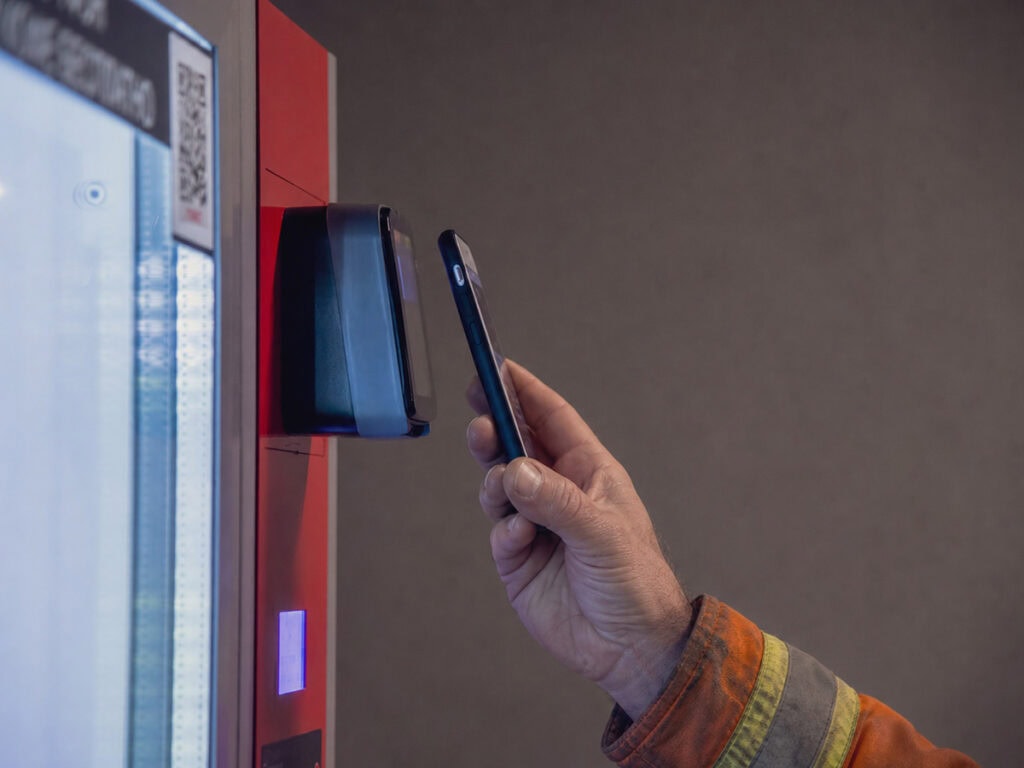
No. The free vending machine requirements do not include any payment equipment or cash handling for the site. A1 Vending’s machines are cashless, accepting tap-and-go cards, mobile wallets and smartwatches.
Can a larger site have more than one machine under the free vending machine requirements?
Yes. Larger sites and busy crib rooms can run a mix of machines, such as a compact snack machine alongside a high-capacity drink machine, and the free vending machine requirements are assessed for the site as a whole.
What information should I send to check the free vending machine requirements for my site?
Send the site location, the number of people on site, the shift or roster pattern, where the machine would go and any induction or access steps for technicians. With those details, A1 Vending can check your site against the free vending machine requirements and confirm what is practical.
Check your site against the free vending machine requirements
The free vending machine requirements come down to six practical checks: regular users, a sheltered location, a power point, technician access, a workable service run and a site contact. A1 Vending has applied them on Goldfields sites since 1997, and most sites can answer them in a few minutes.
Run through the checklist, add your site location and roster pattern, and A1 Vending will confirm coverage and the best setup for your site.
Call 0407 297 200 | Email a1.vending@bigpond.com | Open 24 hours for fault reporting.
Vending Machine Downtime on FIFO Sites: Why changeover day matters and how to keep it near zero
Vending Machine Restocking Service: How service runs reach remote WA sites
What to do if a vending machine payment failed
Join Our Blog
Join a community that cares - subscribe for insights and updates.
"*" indicates required fields